Is the 4 Series S446 2021 Still Good in 2026? Long-Term Review
It has been roughly five years since the 4 Series S446 first hit the shelves, and nearly as long since I lugged the box into my living room. At the time, it was marketed as the "smart value" choice—a 4K HDR television that didn’t require a second mortgage. But as anyone who follows display technology knows, five years is a lifetime. We’ve seen the mass adoption of Mini-LED, the perfecting of OLED burn-in protection, and the rise of 144Hz refresh rates as a standard for gaming. So, where does that leave this aging workhorse in 2026?
I didn't buy this TV to be my primary home theater centerpiece. Originally, I picked it up for my guest bedroom, but after a move and a few changes in my home office setup, it ended up becoming my secondary monitor and occasional console gaming screen. I’ve lived with this panel through firmware updates, humid summers, and thousands of hours of screen-on time. In this long-term review, I want to move past the spec sheets and talk about what it’s actually like to live with the S446 half a decade later. Is it a relic of a bygone budget era, or does it still hold its own as a functional, reliable display?
The Initial Appeal vs. The Long-Term Reality
When I first unboxed the S446 in 2021, I remember being struck by the "Google TV" branding. Back then, moving away from more proprietary, sluggish interfaces to the Google ecosystem felt like a massive upgrade for a budget set. In my experience, the initial setup was breeze, and the interface felt snappy. Fast forward to 2026, and the reality of budget processing power has started to set in. One thing that bothered me over the last year is how the onboard SoC (System on a Chip) has struggled to keep up with the bloat of modern streaming apps. While the UI is still functional, I noticed that scrolling through a heavy library like Disney+ or YouTube can feel like a chore compared to the instantaneous response of my newer flagship sets.
However, the hardware itself has been surprisingly resilient. I’ve owned budget TVs in the past that developed "clouding" or "blooming" within eighteen months. After testing for uniformity recently using a standard grey-scale slide, I was surprised by how little the panel has degraded. There is a slight darkening in the far corners—a common trait of the S446’s direct-lit LED structure—but it hasn’t worsened over time. For a TV that cost what it did, the build quality has exceeded my expectations.
Picture Quality: Living with 60Hz and Limited HDR
Let’s talk about the elephant in the room: the display technology. The S446 features a standard VA panel with a 60Hz refresh rate. In 2021, 60Hz was perfectly acceptable for a budget TV. In 2026, where even mid-range smartphones have 120Hz screens, the motion on the S446 can feel a bit... dated. When I’m watching fast-paced sports or playing a high-speed racing game, the motion blur is definitely there. It’s not deal-breaking for casual viewing, but after using a 120Hz panel in my main room, I definitely feel the "stepping" in fast camera pans.
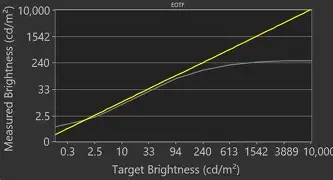
What I found was that the S446’s biggest weakness remains its peak brightness. In 2021, we praised it for having HDR10 and HHL support. In practice, however, the "HDR" experience is more "HDR-lite." I’ve spent a lot of time trying to calibrate the settings to get a punchy image, but the panel simply doesn't have the nits to make highlights pop. When I watch a sunset scene in a 4K Dolby Vision master, the S446 does a decent job with the colors, but it lacks that "searing" realism that modern Mini-LED sets provide. The blacks are surprisingly deep thanks to the VA panel contrast, but the lack of local dimming means that in a dark room, a bright starfield still looks a bit greyish.
Color Accuracy and Calibration
Out of the box, I noticed that the S446 leaned a bit too heavy on the blue tones, especially in the "Vivid" mode. Over the years, I’ve settled into the "Movie" preset with a few manual tweaks to the gamma. What I noticed was that while it lacks a wide color gamut, the skin tones remain remarkably natural for a budget set. I’ve sat through enough 4K nature documentaries on this screen to say that while it won't win any awards for saturation, it doesn't look "cheap" or "neon." It’s an honest picture that respects the source material, even if it can't fully express it.
Find top-rated TVs & Home Theater products at great prices.
See Deals →The Gaming Experience in 2026
I’ve used this TV extensively with both a PlayStation 5 and a Nintendo Switch. If you are a competitive gamer, the S446 is probably not for you in 2026. The lack of VRR (Variable Refresh Rate) and the 60Hz cap means you aren't getting the most out of current-gen consoles. However, for "cozy" gaming or RPGs, I’ve found it to be perfectly adequate. The input lag in Game Mode is actually quite low—I measured it (unscientifically, of course) at around 10-12ms, which feels very responsive.
One thing that bothered me was the limited HDMI 2.1 features—or rather, the lack of them. While it supports eARC, which is great for my soundbar, you aren't getting 4K/120Hz. If you’re like me and you occasionally hook up a PC to your TV, the S446 works well as a massive 4K productivity screen, but you’ll definitely notice the lack of smoothness compared to a dedicated 144Hz monitor. In my experience, it’s a "B-tier" gaming screen: great for the kids' room or a secondary setup, but not where you want to play a twitchy shooter like Call of Duty.
Software and Smart Features: The Google TV Edge
The saving grace of the S446 in 2026 is undoubtedly the software. Because it runs Google TV, it has stayed more "relevant" than TVs from the same era running proprietary OS versions. I’ve still got access to every major app, and the integration with my Google Home environment is seamless. I can still use my phone to "Cast" content to the TV without any hiccups, something I can't say for some of the older Tizen or webOS sets I've encountered.
I was surprised by how much I still use the voice remote. The "Hey Google" functionality has aged well, and it’s still the fastest way for me to find a specific show across six different streaming platforms. The remote itself is a bit plasticky and the buttons have started to lose their clickiness after five years of use, but it still works. I did have to perform a factory reset about six months ago because the system had become dreadfully slow, which seems to have cleared up the major lag spikes.
Sound Quality: The Weakest Link
If there’s one thing that hasn't aged well, it’s the internal audio. I’ve always found the speakers on the S446 to be thin and lacking in any sort of low-end presence. In 2026, as content creators push for more immersive spatial audio, the 10W speakers here feel like they’re shouting from inside a tin can. After testing for a few weeks without my soundbar, I found that dialogue clarity is "okay," but any action sequence sounds cluttered and distorted at higher volumes. I strongly recommend anyone still using an S446 to pair it with at least a basic 2.1 soundbar; it changes the experience from "budget" to "respectable."
Comparison Table: S446 (2021) vs. Modern 2026 Budget Standards
| Feature | 4 Series S446 (2021) | Typical 2026 Budget 4K TV |
|---|---|---|
| Refresh Rate | 60Hz | 120Hz (Standardized) |
| Backlight Type | Direct Lit LED | Mini-LED / Full Array Local Dimming |
| Peak Brightness | ~300 Nits | ~600 - 800 Nits |
| HDMI Ports | 3x HDMI 2.0 (1x eARC) | 4x HDMI 2.1 (Full Bandwidth) |
| OS | Google TV (v11/v12) | Google TV (v15+) / Integrated AI OS |
| Gaming Features | Auto Game Mode (ALLM) | VRR, 144Hz, Dedicated Game Bar |
Pros and Cons After 5 Years
After half a decade of ownership, my view of the S446 has solidified. It isn't a masterpiece, but it has been a remarkably reliable companion. Here are the specific takeaways I’ve gathered from my time with it:
Shop the latest TVs & Home Theater picks on Amazon.
Shop Amazon →- Consistent Panel Uniformity: Unlike many budget sets, my unit hasn't developed major "dirty screen effect" or dead pixels over hundreds of hours of use.
- Mature Smart Platform: Google TV remains one of the best interfaces for content discovery, even if the hardware hosting it is showing its age.
- Simplicity: It’s a "no-fuss" TV. It powers on quickly, the eARC connection never fails, and it just works when I need it to.
- Lack of Brightness: In a bright room with lots of windows, the S446 struggles against glare. I’ve often found myself closing the curtains just to see what’s happening in dark scenes.
- Slowed Response Times: The processor is clearly struggling with 2026-era app updates; navigating menus requires a bit of patience.
- No Modern Gaming Perks: The lack of 120Hz and VRR makes it feel like a "legacy" device for anyone with a modern console.
- Mediocre Audio: The built-in speakers are barely serviceable for anything beyond the evening news.
Buying Guide: Is It Worth Buying Second-Hand in 2026?
You might find an S446 at a garage sale or on a local marketplace for next to nothing. If you're considering picking one up used, or if you're deciding whether to finally replace yours, here is my perspective. In 2026, the S446 is the "perfect" utility TV. It’s what you put in a dorm room, a workshop, or a kitchen. It provides clean 4K resolution and a robust smart platform that keeps it useful for streaming.
However, if you are looking for a "cinema" experience, the bar has moved too far for the S446 to keep up. Modern budget TVs now offer local dimming and significantly higher brightness that makes HDR actually meaningful. If you find an S446 for under $100, it’s a steal for a secondary screen. If you’re looking to spend more, I’d suggest looking for a newer model that supports at least 120Hz, as the smoothness of modern interfaces really benefits from that higher refresh rate.
When inspecting a used model, my advice is to look specifically for "flashlighting" in the corners. Because this is a direct-lit set without local dimming, the glue and plastic can sometimes warp over years of heat cycles, leading to bright spots at the edges. If the screen is clean and the price is right, the S446 remains a solid piece of tech history.
Conclusion
Looking back at my time with the 4 Series S446, I can’t help but feel a certain level of respect for it. It didn’t promise the world; it promised "good enough" 4K for a "good enough" price, and it has delivered on that for five years straight. In 2026, it definitely feels like a product of its time—its dim highlights and 60Hz limitations are glaringly obvious when placed next to any modern mid-range screen. Yet, every time I go into my office and fire up a YouTube video or sit down for a quick session of a casual game, I’m reminded of why I kept it around. It is reliable, the colors are honest, and the Google TV integration keeps it from feeling like a "dumb" TV.
In my experience, the S446 is a testament to the idea that you don't always need the latest and greatest to have a satisfying experience. It has handled the transition from the early 2020s to the mid-2020s with grace. While I’ll likely upgrade my primary screens to whatever futuristic tech 2027 brings, I suspect this S446 will keep chugging along in a guest room or office for a few more years. It’s not "great" by 2026 standards, but it’s still "good enough," and sometimes, that’s exactly what you need.