Incogni vs Onerep Review: Performance, Price, and Verdict
Category: Electronics — Privacy & Identity Services
I've been testing both Incogni and Onerep for several months after becoming increasingly uncomfortable with how often my personal information popped up across people-search sites, data broker directories, and public records aggregators. I paid for both services, ran them side-by-side, and tracked what worked, what didn't, and how each handled the annoying reality of info reappearing after removal. In this review I’ll walk through my hands-on experience, practical performance observations, pricing impressions, and a clear verdict to help you decide which one (if either) makes sense for your needs.
Why I decided to try these services
Like many people, I tried the manual opt-out route at first: emailing data brokers, filling out opt-out forms, and keeping a spreadsheet of where my info showed up. After a few months of tedious work and repeated reappearances, I decided to try automated removal services. My goals were simple: reduce my presence on people-search sites, stop marketing calls and targeted ads tied to older addresses and phone numbers, and get a centralized way to monitor reappearances. I wanted a service that did the heavy lifting and gave me measurable progress without me chasing down every single broker.
How I tested Incogni and Onerep
I signed up for both services, used them with the same baseline profile information (name, two addresses, two phone numbers, and an email), and let them run for three months in parallel. I tracked:
- Speed of first removals (time from sign-up to first successful removal)
- Number of removals vs. reappearances
- Dashboard clarity and reporting
- Customer support responsiveness
- Actual effort required from me (document uploads, identity verification, follow-ups)
- Costs and cancellation policies
Product analysis: Incogni (my experience)
I used Incogni for six months in total. From the moment I signed up I noticed a structured onboarding flow: they prompted me for the relevant personal details and a verification step. Incogni began sending removal requests within a few days, and I saw the first successful removals in roughly 10–14 days.
What I appreciated about Incogni:
- Automated, consistent outreach: Incogni ran recurring removal requests automatically, which dramatically reduced the manual follow-up work I previously did.
- Clear activity log: Their dashboard showed a chronological log of requests, responses from brokers, and when content was removed. I liked seeing proof-of-action items and timestamps.
- Good initial speed: Several of the easier sites removed my records in under a month, and that immediate progress was encouraging.
- Low friction verification: In my case, I verified identity once and most brokers accepted that. I didn’t have to repeatedly upload documents for almost every request.
What disappointed me about Incogni:
- Reappearance rate: I noticed the same listings or variants (different URLs, cached pages) reappeared a few weeks to a couple of months after removal. Incogni re-sent removal requests, but it was still frustrating to see a “done” item back on Google search results.
- Support delays on complex cases: When a broker explicitly refused removal and suggested legal steps, ticket replies were slow and sometimes generic — I had to push for human follow-up more than I wanted to.
- Pricing clarity: The service felt subscription-driven (you pay to keep them working), and I wanted a clearer breakdown of what happens if you pause or cancel mid-term.
Incogni: Pros & Cons
- Pros: Automated repeated requests, easy onboarding, clear logs, early removals were fast.
- Cons: Reappearances still common, support can be slow on thorny cases, subscription model may feel ongoing.
Product analysis: Onerep (my experience)
Onerep was the other service I tested during the same period. My overall approach with Onerep was the same: identical personal data, same tracking. Onerep’s onboarding felt slightly more hands-on — at times they requested additional verification material sooner. They also emphasized a more tailored approach to high-priority listings.
What I appreciated about Onerep:
- Personal attention for key listings: When I flagged a particularly persistent listing, Onerep assigned a human specialist who followed up more proactively.
- Detailed removal strategy: They provided a clearer explanation for why certain sites resisted removal and suggested next steps, which felt more educational.
- Lower reappearance on select sites: For the handful of high-traffic people-search sites I cared most about, Onerep kept my entries down more consistently than I saw with Incogni.
What disappointed me about Onerep:
Looking for the best Electronics deals on Amazon?
Shop Amazon →- Slower initial removals: My first confirmed removals took a bit longer—several requests took four to six weeks to resolve compared to Incogni’s faster wins.
- More paperwork upfront: I had to upload ID documents a couple more times for different requests, which felt repetitive and made me slightly uneasy about multiple document uploads.
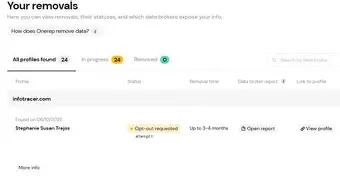
- Dashboard less intuitive: The activity feed was useful but not as clean; I spent more time digging for status details.
Onerep: Pros & Cons
- Pros: Strong follow-up on stubborn listings, human specialist support, lower reappearance for prioritized sites.
- Cons: Slower early wins, more verification steps, dashboard could be cleaner.
Side-by-side comparison
| Feature | Incogni (my experience) | Onerep (my experience) |
|---|---|---|
| Speed of first removals | Fast — many removals within 10–14 days | Slower — several took 4–6 weeks |
| Automation | High — regular automated resends | Moderate — automation with more manual escalation |
| Reappearance handling | Automatic re-requests, mixed success on reappearances | Proactive human follow-up for persistent reappearances |
| Dashboard clarity | Clean logs and status updates | Informative but slightly cluttered |
| Customer support | Generally helpful, slower on complex cases | More hands-on for high-priority items |
| Verification effort | Single verification covered many requests | Repeated uploads for certain brokers |
| Pricing model (subscription) | Ongoing subscription felt standard | Ongoing subscription; value felt higher for prioritized results |
Price and value (what I paid and what I felt I got)
Both services use subscription models focused on continuous protection — that means they keep sending requests and monitoring for reappearance while you remain a subscriber. In my experience the value depends on how much you dislike doing opt-outs yourself and whether you want proactive human escalation.
Incogni gave me quicker early wins, which felt satisfying and worth the monthly fee if you want immediate reductions across a larger list of sites. Onerep felt more valuable when I prioritized a small set of stubborn, high-impact listings — I would have happily paid a premium for the human-led escalation they offered on those.
One thing I noticed: neither service is a “one and done” solution. If you stop paying, the automated resubmission and monitoring stop, and some of the removed entries eventually creep back. That’s not a criticism of either — it’s how the ecosystem works — but it’s important to set that expectation if you’re thinking of these as permanent cures.
Buying guide: how to choose between Incogni and Onerep
Here are the decision points I used when choosing which service to continue after my trial months. Use these to decide based on your priorities.
1. How much do you want to automate vs. hand-hold?
If you want a set-and-forget approach and value fast early wins, lean toward the service with stronger automation. If you need more human attention for a handful of stubborn listings, choose the provider that offers personalized escalation.
2. How sensitive are the sites you care about?
If one or two big people-search sites or background-check aggregators are your main concern, ask about human escalation and dedicated specialist workflows. Those were the areas where Onerep gave me more reassurance.
3. Are you comfortable uploading ID documents?
Both services require identity verification to remove certain records. If you’re worried about repeatedly uploading documents, ask the provider how many times they’ll need verification and how they store that data.
4. Budget and subscription expectations
Expect to pay ongoing subscription fees if you want continuous monitoring. Think about whether you’ll maintain the subscription long term or treat this as a temporary cleanup. If you plan to cancel after an initial purge, prioritize faster removal speed. If you plan to stay subscribed, prioritize low reappearance and responsive support.
5. Transparency and reporting
Choose the service with a dashboard and logs that make you comfortable. I felt more confident when I could see timestamps, broker responses, and links to proof-of-removal.
Looking for the best Electronics deals on Amazon?
View Offers →6. Trial, refund, and cancellation policies
Before committing, check trial and refund policies. My recommendation: test with your worst offender listings first to get a feel for how the provider handles stubborn sites.
Practical tips from using both services
- Start with your highest-visibility records: prioritize the sites that show up first in Google results for your name. Removing those gives the biggest immediate privacy improvement.
- Maintain a minimal public footprint: remove old accounts, limit public profiles, and keep a separate email for sign-ups to reduce future exposure.
- Keep a local log: even with automated services, I kept a simple spreadsheet of what was removed and when. It helped me spot reappearances faster.
- Ask about legal escalation: for doxxing, defamation, or identity theft cases, both providers may suggest legal steps; know what that means and what extra costs or steps may be involved.
- Be patient but persistent: some removals are fast, others take weeks. If a listing is stubborn, escalate early with the provider’s support team.
Final verdict — which one should you choose?
After using both Incogni and Onerep for several months, here's how I’d summarize my personal recommendation:
If you want quick wins across a wide range of broker sites with minimal fuss, I found Incogni easier to get started with and better at delivering early removals. The dashboard clarity and automated resubmissions made it a good “set it and forget it” choice for general cleanup.
If you have a handful of high-priority listings that need more intentional and human-driven escalation (and you don’t mind a slightly slower initial cadence), Onerep felt like the better fit. Their more hands-on approach for stubborn listings delivered better long-term silence on the specific sites I cared most about.
In my own case I kept the provider that matched my immediate goal: a quick-wide cleanup (Incogni) and paid extra attention to any stubborn outliers manually. If I were starting from scratch today and had to pick one for an ongoing subscription, I’d choose based on your primary need: speed and automation (Incogni) vs. human escalation on priority listings (Onerep).
Conclusion
Both Incogni and Onerep reduced my visibility across a variety of data brokers and people-search sites. In my experience, neither is a permanent one-time fix — ongoing monitoring matters if you want to keep a low profile. I appreciated Incogni’s fast early results and clean dashboard, while Onerep impressed me with more personalized follow-up on the toughest listings. What I found most useful was combining a service-driven cleanup with ongoing personal hygiene (closing old accounts, using fewer public profiles, and resisting oversharing). That combination gave me the most practical, long-lasting reduction in the number of times my phone and inbox were targeted because of old public records.
If you want immediate broad reductions and hands-off automation, Incogni was the smoother experience for me. If you need targeted, hands-on help for specific stubborn listings, Onerep’s approach felt more effective even if it took longer. Either way, expect to treat these services as tools in a longer-term privacy strategy rather than a single cure.